


Have you ever stepped into something good—something you wanted, something you cared about—and felt your body tense as if you weren’t sure you were ready? That’s where I found myself one morning. I had a presentation coming up, the kind of work that usually lights me up, and yet as soon as I sat down to prepare, my thoughts jumbled up and my chest felt tight. Finding safety in the unknown isn’t just something we talk about in quiet time. It shows up in real life, in real stress, right when we’re trying to move forward.
Finding Safety in the Unknown When Your Body Begins to Brace
Finding safety in the unknown doesn’t usually happen by default. Even when nothing is technically “wrong,” our bodies pay close attention to patterns.
If you’ve walked through seasons where
- you became the strong one because no one else could
- you had to figure things out on your own
- responsibilities stacked up faster than you could keep up
- change arrived before you felt ready
your body remembers.
It remembers what it felt like to be overloaded, unsure, stretched thin, or on constant alert. And because of that, it responds: a tight chest, a shallow breath, racing thoughts, a sense that everything needs to be handled all at once.
That response is very human.
God designed your nervous system with a purpose. It’s built to alert you, to flag what feels unsafe, to make sure you pay attention. It is part of how He wired you to move through a world that is often unpredictable.
You were created to notice these signals and bring them into conversation with God.
What Your Body Is Telling You as You Seek Finding Safety in the Unknown
In my Pilates training and practice, I’ve learned something that also applies to everyday life: breath is not an accessory, it’s central. The inhale and exhale cue your muscles when to engage and when to release. Breath coordinates the whole movement. When breath is dismissed or disconnected, the movement loses its grounding, and your body ends up doing more but receiving less. But when breath is welcomed as a partner, the body responds with alignment, strength, and a sense of safety that’s felt from the inside out.
The same is true in life. Just like in Pilates, when you meet life circumstances with breath—when you slow down enough to notice your inhale and exhale—you begin to shift from reacting to responding. You become more present. And in that presence, you create space to hear what your body is saying… and what God is saying. Breath becomes not just a physical tool, but a spiritual invitation to partner with how God designed you to move forward with clarity instead of panic, with grace instead of strain.
Your nervous system isn’t just trying to shield you from anything uncomfortable. It’s sending information:
- This feels like too much.
- I don’t know what’s going to happen.
- I’m afraid I’ll miss something important.
- I’m worried I won’t be able to hold all of this.
Sometimes that signal is a reminder to slow down and break something into smaller steps. It might be a nudge that you’re saying yes to too many things. Or maybe it’s a warning that a situation truly isn’t safe or healthy.
These signals matter. They are your body’s clues that help you understand what’s happening beneath the surface. God designed a body that responds: to get your attention, to help you notice what needs care, and to draw you back to Him for wisdom about what to do next.
So instead of fighting your body or dismissing it, you can ask:
- What is my body trying to tell me right now?
- What do I think is at risk?
- Where have I felt this way before?
- What do I need from God in this exact moment?
How God Helps Us in Finding Safety in the Unknown
God sees every place in you that feels stretched, strained, or close to burned out. He is fully aware of the tension in your body, the way your shoulders lift when you’re unsure, the way your breath shortens when you don’t know how something will work out.
“A bruised reed He will not break, and a smoldering wick He will not snuff out…” ~ Isaiah 42:3 (NIV)
It’s a short verse, but it says so much about the heart of Jesus.
In ancient times, a reed was a fragile plant—once bent or bruised, it was seen as useless and thrown away. But this passage tells us that Jesus doesn’t toss aside the weak or weary. If life has bent you low, He doesn’t break you off. He moves toward you with care.
And then there’s the smoldering wick—a faint, flickering flame barely holding on. In those days, wicks that stopped burning cleanly were usually pinched out and replaced. But not with God. When your hope feels thin or your faith nearly gone, He doesn’t snuff it out—He gently breathes life into it.
This verse isn’t just poetic. It’s a promise: that Jesus doesn’t abandon us when we feel fragile, forgotten, or unsure how to go on. He comes close, strengthens what’s weak, and restores what feels useless. He sees the flicker in you and fans it into flame.
This verse gives us a picture of a God who is attentive and careful. He doesn’t bypass what your body is signaling or expect you to push yourself past your limits. He works with how He made you—spirit, soul, and body—so that you can walk forward with Him in a way that is honest and sustainable.
Sometimes His care looks like a quiet reassurance. He may be giving you a clear warning. Or maybe He’s asking you to reorder something in your life before you move ahead.
The point is not to ignore or push past your body’s signals, but to pay attention to them with God.
Paying Attention to Your Body on the Journey of Finding Safety in the Unknown
One of the most important shifts we can make is to start noticing what happens in our bodies. Not as a project to fix ourselves, but as a way to cooperate with how God designed us.
Maybe you notice your mind jumping to possible outcomes, or your thoughts race ahead instead of staying with the next step. Physically your jaw may clench, your breath gets short, or your stomach feels unsettled.
Instead of brushing those things aside, you can pause and ask:
- What am I imagining right now?
- What am I afraid this will cost me?
- Where do I need courage?
- What is God showing me in this reaction?
This is where journaling becomes powerful. Put words to what your body is doing. Name the thoughts that are swirling. Bring them before God on paper. Often, clarity begins to reveal the real fear, the real story you’re telling yourself, the real weight you’re carrying.
From there, you can make more thoughtful choices:
- Do I need to break this into smaller pieces?
- Do I need to ask for help?
- Is this a step of obedience I’ve hesitated to take?
- Is God revealing a boundary I need to set?
Finding Safety in the Unknown with God
Stepping into the unknown will probably always stir something in you. That’s part of being human and paying attention. The goal isn’t to eliminate the bracing but to recognize it sooner and ask questions with God:
- What is this reaction telling me?
- Where do I need Your courage, God?
- What needs to be reordered?
- Where are You already at work in this?
Finding safety in the unknown is about knowing that when your nervous system lights up, you have a place to go for clarity and strength.
You can pause and seek God’s wisdom for what this moment means.
Then you can take the step in front of you—aware and walking in cooperation with the way God made you.
If You’d Like to Go Deeper
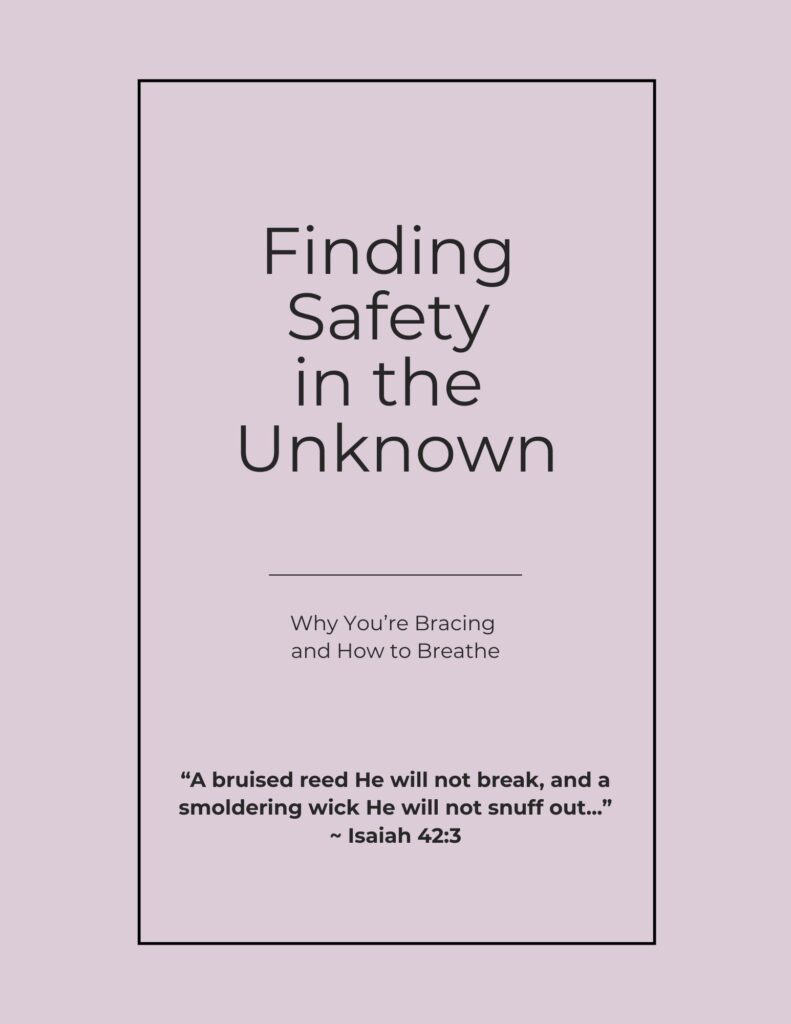
If this message resonated with you, get the free companion journal here that will guide you through paying attention to your body’s signals, asking honest questions with God, and writing through the places where you tend to brace. As you work through it, my hope is that you’ll begin to see patterns, hear His guidance more clearly, and experience a deeper sense of safety with Him. . . even when the road ahead isn’t fully clear.
I’d Love to Hear From You
What’s one way your body tries to get your attention when you’re stepping into the unknown. . . and how are you learning to respond with grace?



I love this! I found myself feeling anxious the other day and noticed how much breath movement helped my physical body calm. Remembering that the things I am feeling anxious about is all a part of His plan and he is using it towards something wonderful in my life! Thank you for these beautiful words!
Movement and breath awareness has been a big part of returning to a place of regulation for me in this crazy, wonderful world we live in as humans! Thank you for sharing that this pointed you back to God and His good plan for your life!
Wow, the teaching on the Isaiah passage is SO good. Thank you for that insight and all you wrote, Tracy! I was able to figure out how to share this with another who is not on Instagram!
I’m so glad this spoke to you! God really got my attention with this Isaiah passage 💫